Sources say, students riding motorized scooters, bikes and skateboards on SDSU’s campus are breaking the law for multiple reasons.
By Emilyn Mohebbi
Dec. 4, 2018

A popular and convenient type of transportation, electric scooters, bikes, and skateboards are becoming the norm around SDSU’s campus. Whether students own their own, or they are temporarily renting one through one of the new innovative apps, according to SDSU Parking and Transportation Services Director, Debbie Richeson, the scooters seem to be multiplying by the day, causing an influx on campus.
The motorized scooters can be dangerous if not operated properly, especially if speeding through a campus full of walking students. SDSU’s Parking and Transportation Services sent out an email two months ago to students, reminding them of safety precautions and laws which could lead to administrative citations if disobeyed. Sources say that students on SDSU campus are breaking the law every time they operate a motorized scooter, bike, or skateboard without wearing a helmet. “Right now the law is that helmets are required. So everyone is breaking the law. Whether they’re on campus or not,” Richeson said. Captain of the SDSU Police Department, Matt Conlon said, “I would say that wearing helmets is uncommon in the SDSU area. I have rarely, if ever, noticed people wearing helmets.”
SDSU Energy and Sustainability Officer and Facilities Services Assistant, Tom Abram gave a very low number of SDSU students wearing helmets as well. “Out of the thousands of times I’ve seen people on scooters, bikes, and skateboards, maybe one time I’ve seen a helmet. No students are wearing helmets on this campus. They’re all technically breaking the law,” Abram said.
One of the new laws that will take effect on Jan. 1, 2019, is anyone over the age of 18 is not required to wear a helmet while operating an electric scooter. “The bill would require the operator of a motorized scooter to wear a helmet only if the operator is under 18 years of age,” states California Legislative Assembly Bill.
According to a Bird spokesperson, the company is making it possible for everyone to own a helmet. “We strongly encourage all riders to wear helmets. To help ensure that all people have equal access to helmets, Bird provides them to riders for free. We have given away more than 50,000 free helmets,” a Bird spokesperson said.
At UCSD, the increase of motorized scooters, bikes, and skateboards hasn’t been as drastic as SDSU’s influx, according to UCSD Assistant Chief of Police, Greg Murphy. “Yes, there has been an influx, but the degree has not been overwhelming compared to other sections of San Diego County,” Murphy said. According to Murphy, about 15 percent of students operating motorized scooters on the UCSD campus have been seen wearing helmets.
Other than students not wearing helmets, there are other serious concerns in connection to the influx of motorized scooters, bikes, and skateboards on the SDSU campus. “I recently got a report from Student Health Services of incidents from last semester. There were around 24 incidents reported of bodily injury with a scooter, bike, or a skateboard. It didn’t say whether the scooters were motorized or not,” Richeson said.
With the semester not even complete yet, the incident reports number has doubled. With two weeks left in the semester, incident reports are already up to 40 cases, according to Richeson and SDSU Incident Reports database. “These are students reporting their injuries to Student Health Services. The incidents could be off campus, but students are coming to campus to get services,” Richeson said.

Companies like Bird highly recommend reporting any incidents that their scooters were involved in. “We strongly recommend reporting any damaged scooters or incidents that Bird scooters are involved in, as we have a support team dedicated to safety that is available around the clock to address questions and reports we receive. Bird provides a number of ways for people to reach us, including by email, through our in-app messaging feature, and by phone,” a Bird spokesperson said.
Students haven’t been considering the dangers and risks that potentially come with operating motorized scooters, bikes, and skateboards, according to Abram. “A student somehow reached over the opening of a parking structure and dropped a Lime bike between the wall and the parking sign. The bike was hanging up about 20 feet. We also had an incident where somebody threw a bike off of the parking garage and they videotaped themselves. If somebody had been walking under there, they could have died. It’s very unfortunate,” Abram said.
“The biggest issue is definitely safety. People just need to be aware of what is going on and who they are impacting. I think it is fair to say that a lot of our students unfortunately are in a bubble. The biggest thing to work on is just consideration,” Richeson said.
SDSU Community and Media Relations and Special Advisor to the Chief, Raquel Herriott advocates the importance of safety on SDSU’s campus as well. “Our biggest concern will always be safety. While operating electric scooters, we would like our community to remember to use designated pathways and to be cognizant of pedestrians and others while operating electric scooters,” Herriott said.
According to the SDSU Safety Services and Programs website, “The campus has a designated path on Aztec Walk and Campanile Mall, in addition to inner campus roadways for students to ride bikes and skateboards. Riding on any other walkway is a violation of SDSU policy, and can result in a citation.” Citations/administrative tickets were implemented last fall, and cost $75. “Students do have the ability to appeal if they feel that it was unfair. But it is required that students pay for their citation before they appeal it, because most of the time it will not get dismissed; because students saying it is unfair is not grounds for dismissal. There has been some discussion from students on campus to expand the bike lanes to more areas so they are riding where they are supposed to,” Richeson said.
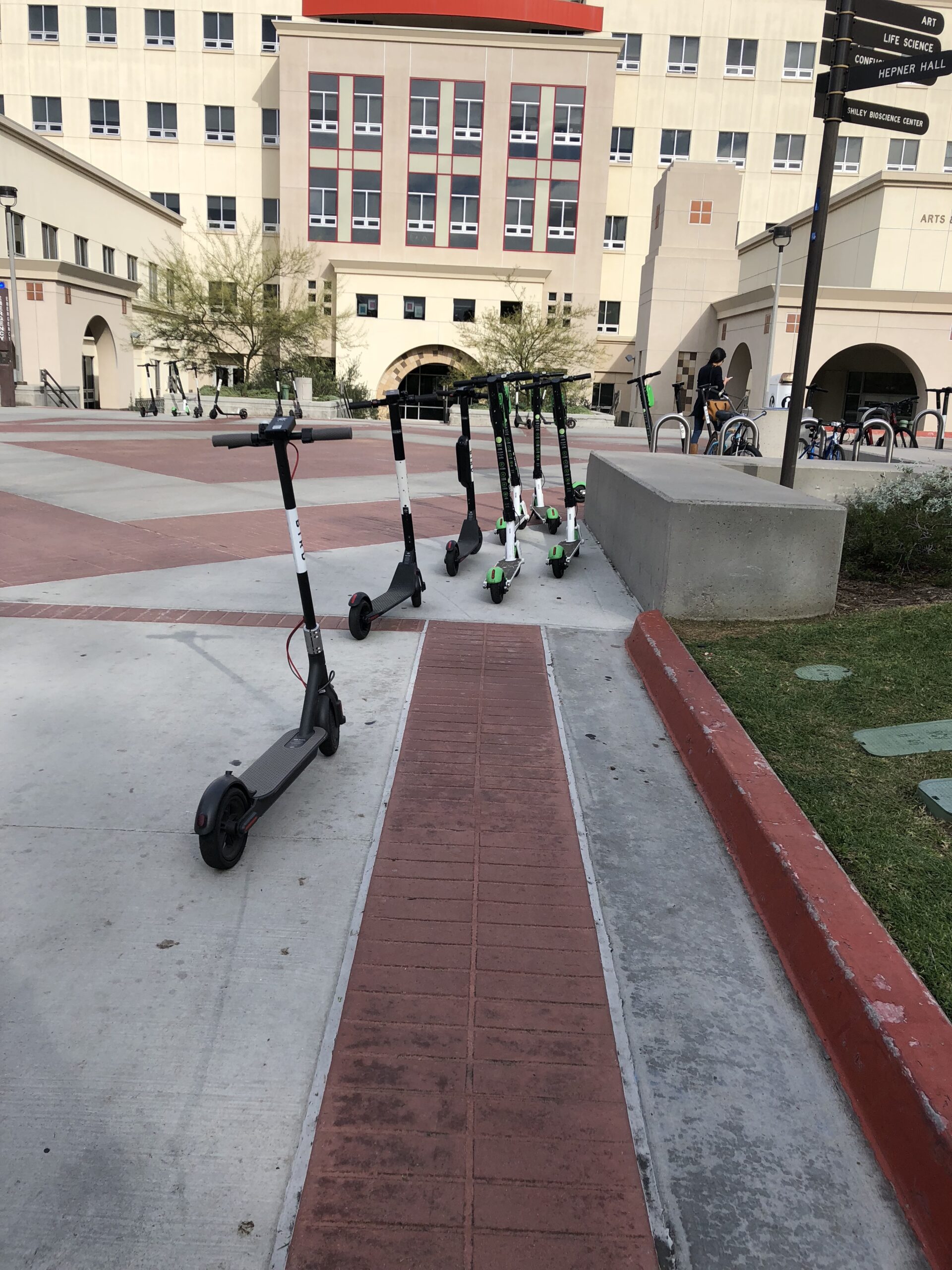
Another problem that comes with the recent influx on campus is accessibility. People will put scooters on sidewalks in a way that it blocks a wheelchair’s access, according to Abram. “So one thing that I want to make sure of is that the companies are operating and staging the motorized scooters properly. Whoever is placing them in the mornings or in the evenings after being charged is making sure not to impede the Americans With Disabilities Act (ADA) access,” Abram said.
Other issues pertain to long-term health. Students aren’t walking as much, which becomes problematic for their future health, according to Abram. Another issue is aesthetics. “One of the other big concerns which takes a backseat to both injuries and long-term health would be the aesthetics. A lot of times motorized scooters, bikes, and skateboards get left in places that aren’t really appropriate; then they leave marks all over campus. It’s really expensive to try and maintain all of these marks the scooters, bikes, and skateboards leave on the ground,” Abram said.
The companies that are currently being operated on SDSU’s campus are Lime, Bird and Razor. Every two weeks a new company is reaching out to SDSU to form a partnership, according to Abram. “The companies contact us because they want to form partnerships. They want to make sure that we allow them to operate here. One of the issues in the past has been companies dumping their bikes or scooters on college campuses. That usually leaves a sour taste in our mouths,” Abram said.
Brainstorming solutions for the issues that come with the influx of motorized scooters, bikes, and skateboards on campus is currently in progress, according to Richeson. “I have actually knowing that this was coming, started a committee group that is going to be a shared governance. We are planning to hopefully meet sometime this month or next month to discuss scooters, and what we want in the Senate Policy File in the Building and Grounds Policy. Do we want them on campus? If so, in what way? I’m going to be bringing a lot of data to the group so they can make an informed recommendation. We will be seeking their input to make a final recommendation to the administration,” Richeson said.
As the committee comes together to come up with a solution for this issue, the companies have been receptive to ideas that SDSU Parking and Transportation Services has proposed, according to Richeson. “We have been in contact with companies such as Lime, Bird, and Razor, because we are trying to come to some sort of agreement while we are waiting on this committee to make a recommendation to administration so we can have some sort of semblance of control,” Richeson said.
“In our conversations with them, we have sent a proposal of what we would like to see occur on our campus in the meantime. Examples would be that they don’t stage on our campus, they remove them at some point in the middle of the night so that we are clear of them in the morning, and they work on the restriction that they talked with the city about a geo-fence around the campus so students can’t go more than eight miles per hour. We also want them to even work with us to geo-fence our bike racks so that they can do penalties through the app if the user doesn’t park it in a bike rack,” Richeson said.
